
It's nearly impossible to argue that when it comes to physical qualities in sport, speed 🏃♂️💨 is probably the most important when it comes to separating good performers from great performers.
That being said, you all know that it's actually much more nuanced than that. Speed, in and of itself, can be divided into several different categories 📊; each one with varying degrees of influence on actual performance.
As far as linear speed goes, max velocity 🚀 gets a lot of attention because it's easy to measure progress 📈 and some coaches have developed large followings by building their entire training philosophy around it.
However, max velocity is a red herring ❌🐟 for performance. The only scenario where this isn't the case is sprinting in track and field 🏟️.
Ideally, what we need to look at is:
➡️ What speed qualities does our sport demand MOST?
➡️ How do we train those qualities outside the sport in ways that integrate seamlessly with it?
This is where acceleration ⚡— in its many forms — becomes supremely important.
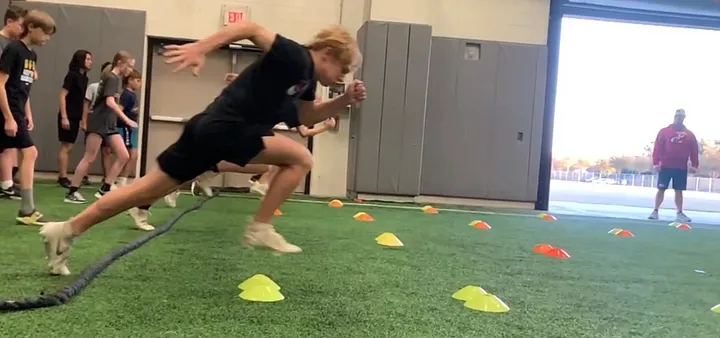
Put simply, acceleration is how quickly an athlete can cover a distance from a static or moving start, in any direction or plane of movement 🔁📐. More often than not, acceleration happens linearly ➡️, but multi-directional or multi-planar acceleration can be just as important.
If you observe sport practice or competition through the lens of multi-directional acceleration 👀, you'll immediately notice how frequently it happens.
Legendary S&C coach Al Vermeil once said that Michael Jordan's superpower 🦸♂️ was his ability to produce force equally in all 3 planes. Seems like a simple enough statement until you think about how much time we commit in training to producing force only in the sagittal plane 🧠🏋️♂️...
Now this isn't a lecture on training in all 3 planes—you’re all smart enough to know that. 🧠💡
It's more about rethinking how we train acceleration 🔄.
My operational definition of acceleration is simple:
📍 Project the center of mass in a specific direction with COM rising gradually from lower to higher as velocity increases.
The principles I use to train acceleration are equally simple:
-
💪 Improve force application – Get athletes strong so they can apply more force to the ground
-
🤝 Improve coordination – Use A-series drills, low-intensity plyos (light and medium tier), and med ball throws / slams to sync upper and lower body
-
📐 Improve shin angles – During the first steps of acceleration, observe shin angles; they should rise from ~45º to ~90º over the first 5–7 steps
The first step (figuratively and literally 🦶) to improve your athletes' ability to accelerate efficiently is implementing A-series drills and this simple linear acceleration progression into your warm-up 🔁🔥 for training sessions and practices 2–3x per week.
This will immediately address the coordination 🤸 and shin angles 📏 components.
In Part 2, we'll dive into how to improve acceleration in the frontal and transverse planes! 🌀↔️
Talk soon,
Tim Kettenring
President – Maverick Human Performance


Responses