
Periodization Isn't Dead: An Experimental Approach to the Problem
Several weeks ago, I introduced the concept of the Fluid Conjugate Periodization model.
The idea was born out of numerous conversations about how coaches go about periodizing lifting in-season.
"How do we train all the qualities we need when we only have 20-30 minutes in a session?"
"How can we actually make progress in strength and power when we have mid-week and weekend matches every week?"
"Linear periodization is the stupidest thing I've ever seen."
"How can we get more out of our Saturday morning lift?"
As a quick refresher: Fluid Conjugate Periodization uses Conjugate Method principles on a rotating and optional auto-regulating basis to ensure athletes get a consistent stimulus of:
-
Max Strength
-
Rate of force development
-
Volume
With this newsletter, I'm going to lay out some practical ways you can implement Fluid Conjugate Periodization in your setting.
Single Competition Week
For fall sports like football, Fluid Conjugate works flawlessly because the schedule is fairly predictable week-to-week. See sample week below:
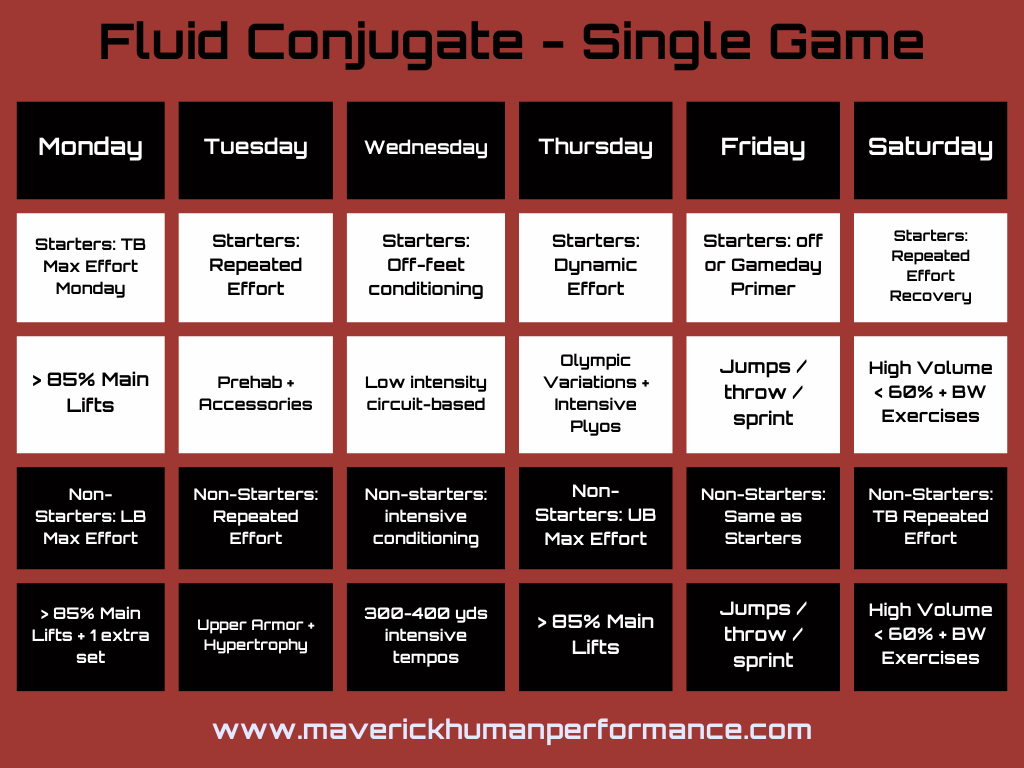
Training week for starting players could be structured as follows:
-
Day 1: early week max strength stimulus
-
Day 2: volume stimulus w/ secondary emphasis on prehab and accessory work
-
Day 3: recovery-oriented conditioning stimulus - can also just be low-intensity sport practice
-
Day 4: dynamic effort speed / power stimulus
-
Day 5 (Gameday): *optional “potentiation” stimulus
-
Day 6: repetition effort recovery stimulus
*I don't actually believe high school developmental athletes’ nervous systems are developed enough to benefit from a potentiation stimulus but I do think they provide an excellent opportunity to create excitement and energy on gamedays.
Non-starters and developmental players will get a max strength lower body stimulus–with one more set than the starters so you don't have to write a completely different program–on day 1, a repeated effort hypertrophy stimulus for armor building on day 2, an intensive conditioning stimulus on day 3, an upper body max strength stimulus on day 4, a similar optional potentiation stimulus on gameday, and a total body hypertrophy stimulus on day 6.
-
Day 1: max strength lower body +1 set*
-
Day 2: repetitive effort hypertrophy / volume stimulus (armor building)
-
Day 3: intensive conditioning stimulus - can be incorporated into sport practice
-
Day 4: max strength upper body +1 set*
-
Day 5: optional gameday “potentiation” lift
-
Day 6: repetitive effort total body hypertrophy / volume stimulus
*instead of writing completely different programs for starters and non-starters, just add 1 set to the starters program for non-starters on max effort days for a bump in volume
I like to follow a 3 up, 1 down progression where intensity or volume increase for 3 weeks followed by a deload in week 4. Integrating 5/3/1 principles on max effort days is a simple and effective way to make sure your athletes continue to get stronger through the season without detraining other qualities or negatively affecting on-field performance.
Multiple Competition Week
Fluid conjugate periodization really shines for fall sports that compete more than once a week like volleyball and soccer.
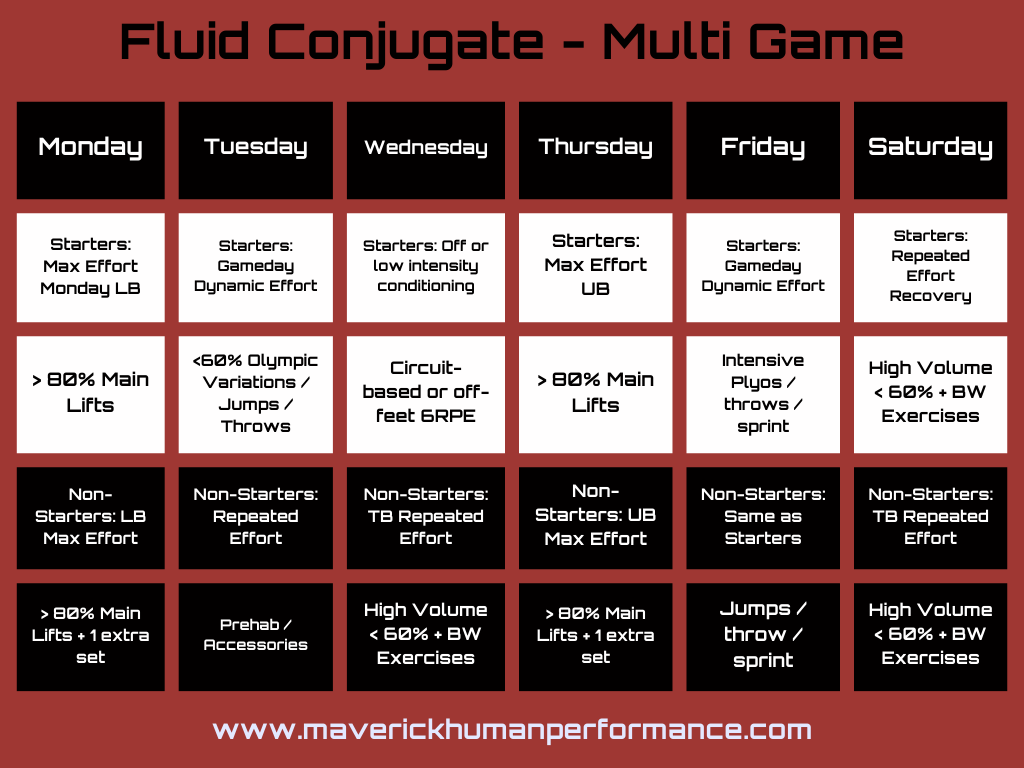
Now I know some of you will look at Day 1 and start screaming at me through your phones or computers, "WHY ARE YOU LIFTING HEAVY THE DAY BEFORE A GAME?!"
So I'll tell you what everyone who's fired up loves to hear when they get fired up:

I'm not saying you need to be doing 8x2 @ > 90% on back squat – but 3x2 @ 85% is a great minimal effective dose max strength stimulus to continue getting stronger through the season.
The same rule applies to Day 2 and Day 5 dynamic effort days aligning with game days as well–much lower volume AND intensity. For example, we all know 5x2 @ 70-80% on hang power clean would be ideal for improving rate of force development. But with in-season training (as in most things), practical > optimal. So maybe we go 2x3 @ 55% and 1x2 @ 65% on hang power clean. This will result in slightly faster bar speed, give space for progression, and potentially elicit a potentiation effect - even though I still don’t think high school athletes’ nervous systems are developed enough for this to have an actual potentiation effect.
Pair the hang power clean with a reactive strength stimulus like a drop jump into hurdle hop and you've got a potent prescription for improving power output and stretch-shortening cycle speed throughout the season.
Day 3 provides an opportunity for recovery and regeneration for starters utilizing cardiac output circuits or similar low intensity conditioning stimulus. It also provides an opportunity for non-starters to shore up areas of improvement or to just accumulate additional training volume.
Days 4 and 5 follow the same max effort/dynamic effort formula as earlier in the week–the exception being that the primary stimulus on day 4 should be either a light, loaded olympic variation or a jump paired with both an intensive med ball throw variation and a sprint variation.
Day 6 is a higher volume, repetition effort recovery-oriented session with opportunities for armor building, accessory, and prehab work that may not fit into other sessions.
Prefer a more auto-regulated approach?
I got you.
Start each session with a simple readiness assessment–some options:
-
Subjective readiness assessment–built into Teambuildr AMS for Platinum Pro users (not a plug, just a statement as many of you use Teambuildr)
-
Or use this one I built in Google Sheets: soreness, mood, sleep rated as either GREEN, YELLOW or RED.
-
Green – little-to-no soreness, positive mindset, good sleep quality.
-
Yellow – moderate soreness, average mindset, average sleep quality
-
Red – significant soreness, poor mindset, poor sleep quality
-
"CNS readiness" assessment – broad jump would be my choice due to validity and simplicity, but you can just as easily use vertical jump or CMJ if you have the equipment and technology
How to modify based on readiness
Both readiness assessments will auto-calculate and color code for individual athletes and for groups.
If modifying on the individual level, you can build in modifications to programming in a notes section or on a whiteboard as follows:
-
If you're RED: reduce to 1-2 working sets of main lift and 1-2 sets of accessories.
-
If you're YELLOW: do the session as prescribed, no modifications.
-
If you're GREEN: add 1 working set to main lift or increase intensity by 2.5-5%.
If a majority of your group or team is RED, it might be necessary to modify the entire session–pivoting from a max effort or dynamic effort to a more recovery-oriented repetition effort session.
This is as simple as pulling the subsequent, repetition-effort session from later in the week and dropping it in on the low-readiness day.
Final Thoughts
Fluid Conjugate Periodization can dramatically simplify your approach to training in-season. There's a little more preparation on the front end, but it's easily repeatable and adaptable when it matters.
I was blown away by the feedback I received from the first Fluid Conjugate newsletter:
"This is f**king LIGHTS OUT!" - 20 year S&C coach
"Most practical idea I've seen for in-season lifting!" - college FB Asst S&C coach
"Implementing this IMMEDIATELY" - 10 year HS S&C
I hope this newsletter gives you some useful resources to build out your own Fluid Conjugate program.
Don't hesitate to reply with questions or to schedule a consult.
Thanks for reading,
Tim Kettenring
Maverick Human Performance
PS Don't forget that the original Cohort is coming back next month, tap in here for more info.
PPS Check out this simple strategy for using density to manage load in practice in this week's content on my Instagram and Twitter (because I refuse to call it X).


Responses